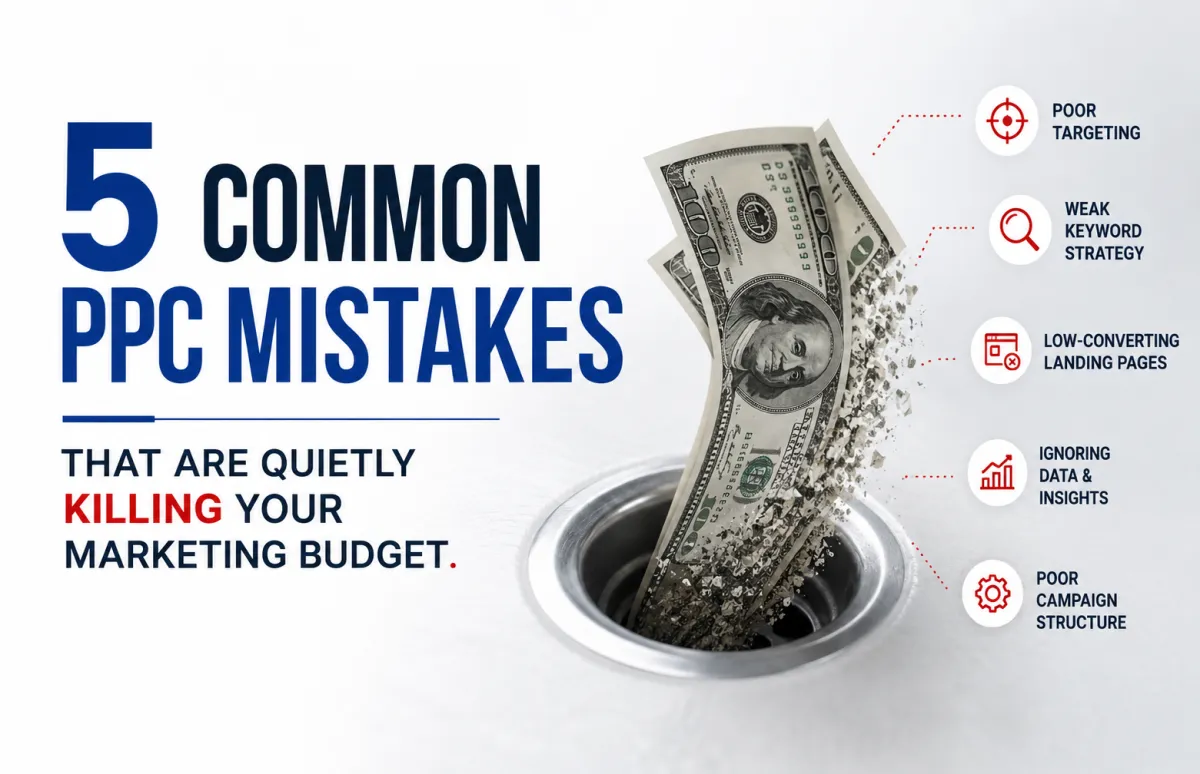
5 Common PPC Mistakes That Are Quietly Killing Your Marketing Budget
5 Common PPC Mistakes That Are Quietly Killing Your Marketing Budget
Imagine lighting a stack of hundred-dollar bills on fire every single morning.
If you are running pay-per-click (PPC) campaigns without a hyper-optimized strategy, that is essentially what you are doing. According to industry data, the average business wastes roughly 25% to 30% of its total ad spend on inefficient, poorly targeted campaigns.
When done right, PPC is one of the fastest ways to scale revenue. But when done wrong, Google and Meta algorithms will gladly swallow your budget without delivering a single qualified lead.
Whether you are a startup founder looking to maximize ROI or a business owner looking to run leaner, identifying these five silent budget killers is the first step toward scaling efficiently.

1. Treating "Broad Match" Like a Safety Net
The single easiest way to burn your budget is to rely entirely on Broad Match keywords.
When you set a keyword to Broad Match, you give Google’s algorithm permission to show your ad for any search query it deems vaguely related. For example, if you run a luxury watch brand and bid on "luxury watches," a broad match algorithm might show your ad to someone searching for "how to fix a cheap luxury watch battery."
You pay for the click, but the user leaves instantly because your landing page doesn't match their search intent.
The Fix: Shift your core strategy to Phrase Match ("keyword") and Exact Match ([keyword]). This ensures your ads only appear when a user uses your precise terms, preserving your cash for high-intent traffic.
2. Neglecting Your Negative Keyword List
Think of negative keywords as a shield for your wallet. They tell the search engine exactly what phrases you do not want to pay for.
If you are a B2B SaaS company selling enterprise software, you absolutely do not want to pay for clicks containing words like:
"Free"
"Cheap"
"Course"
"Jobs"
"Template"
Failing to build a robust, ongoing negative keyword list means you are actively paying for casual browsers, job seekers, and students to navigate your site.
3. Sending Ad Traffic to Your Homepage
If you are paying $5 a click to send traffic directly to your website’s generic homepage, stop immediately.
A homepage is a discovery hub; it has too many links, distracting menus, and no singular focus. When a user clicks a highly specific ad, they expect a highly specific answer. If they have to hunt through your homepage to find what your ad promised, they will bounce within three seconds.
The Anatomy of a High-Converting Destination:
A Singular CTA: One clear goal (e.g., "Download Guide", "Book a Demo").
Message Match: The headline of your page should use the exact language of your ad.
Zero Distractions: Remove standard website navigation menus to keep users focused on converting.
4. Overlooking Mobile-Specific Optimization
It’s a common trap: you build, preview, and launch your ad campaigns on a spacious 27-inch desktop monitor. But what does the experience look like on a smartphone?
If your mobile landing page takes more than three seconds to load, or if your opt-in form requires tiny, frustrating finger taps, your mobile conversion rates will plummet while your cost-per-acquisition (CPA) skyrockets. Given that over half of global web traffic is mobile, a poor mobile UX is an algorithmic death sentence.
5. Blindly Trusting Automated Bidding "Out of the Box"
Modern ad platforms heavily push artificial intelligence and automated bidding systems like Target CPA (Cost Per Acquisition) or Maximize Conversions.
While these algorithmic tools are incredibly powerful, they require data to work. If you turn on automation on a brand-new campaign with zero historical conversion data, the algorithm has to guess. It will spend your money rapidly trying to learn what a converter looks like.

Quick-Audit Checklist: Spotting Inefficiencies in Your Account
To make sure your ad accounts aren't leaking cash, run this quick audit every single week.
1. Review Your Search Terms Report: Weekly.
Go into your active campaigns and look at the exact phrases people typed to trigger your ads. Spot an irrelevant term? Add it to your negative keyword list immediately.
2. Check Your Device Performance Breakdown: Bi-Weekly.
Isolate desktop vs. mobile performance. If mobile clicks cost twice as much per conversion, lower your mobile bid adjustment or fix your mobile landing page.
3. Verify Conversion Tracking: Monthly.
Ensure your tracking pixels are firing properly. If your system incorrectly tracks a simple page view as a hard lead, the algorithm will optimize for the wrong behavior.
The Bottom Line
PPC is not a "set-it-and-forget-it" channel. The algorithms reward advertisers who match clean user intent with seamless, lightning-fast landing page experiences. By tightening your match types, maintaining negative keyword lists, and driving traffic to dedicated destinations, you will naturally out-compete larger brands with sloppy accounts.
Ready to eliminate budget leaks and scale your revenue? Visit MktrHub today to discover advanced marketing strategies that optimize your digital footprint and scale your distribution efficiently.
